
What Is FRP Lining and Why Do Chiller Pipes Need It?
Industrial chiller systems are among the highest-value mechanical plant in any manufacturing facility, commercial building, or data centre. The pipework that carries chilled water from the chiller to the load and returns warm water for re-cooling represents a significant infrastructure investment — and when that pipework corrodes, the consequences are expensive.
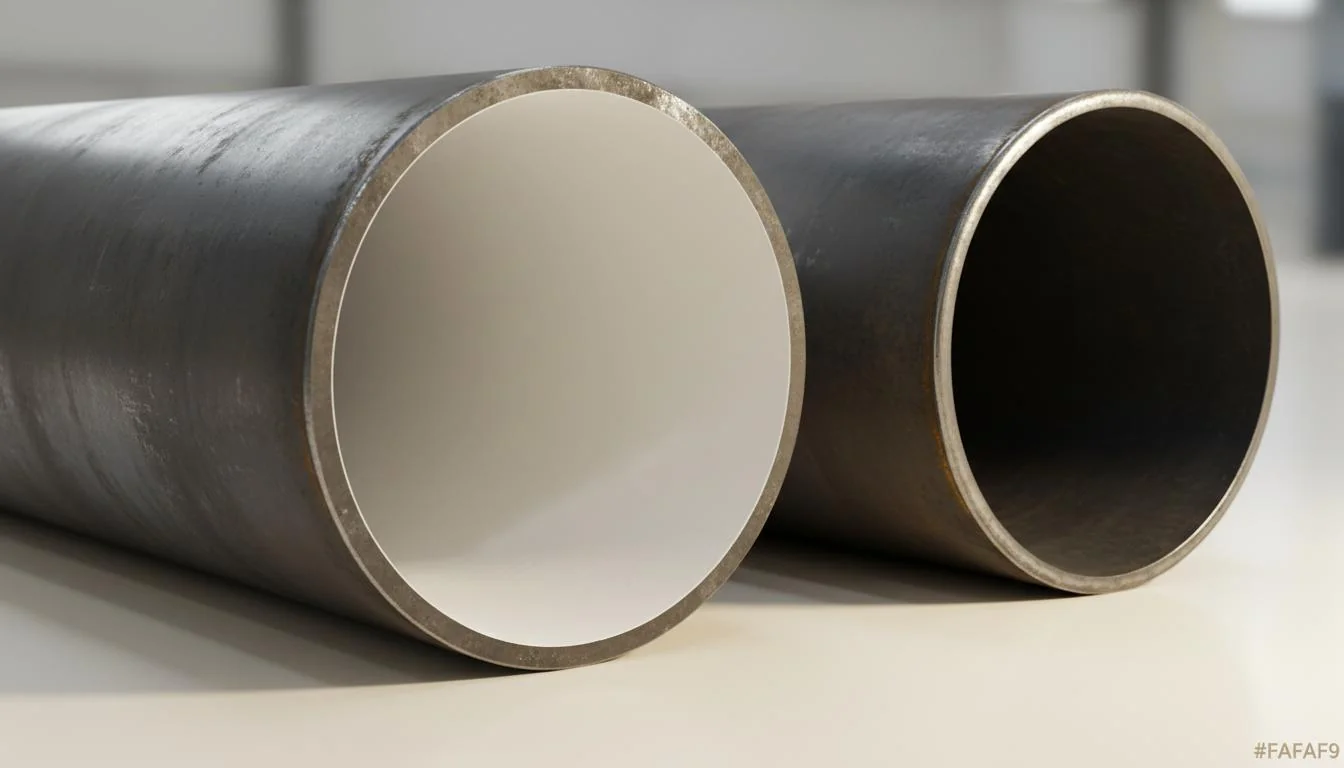
FRP (Fibre Reinforced Plastic) lining is a pipe rehabilitation technique that addresses internal corrosion in chiller pipes without the cost, disruption, and downtime associated with full pipe replacement. Applied in-situ (in-place) to the interior of an existing pipe, FRP lining creates a new, smooth, corrosion-resistant surface inside the old pipe — effectively renewing the pipe's service life from the inside.
Why Chiller Pipes Corrode
Chiller water circuits are particularly susceptible to internal corrosion for several reasons:
Dissolved oxygen: Open cooling circuits and improperly commissioned closed loops can contain dissolved oxygen that drives electrochemical corrosion in steel and galvanised pipes.
pH variability: Cooling water chemistry varies with temperature changes, biocide additions, and water hardness fluctuations. If pH control lapses, even briefly, corrosion accelerates.
Microbial activity: Bacteria (including Legionella) in cooling water systems can accelerate corrosion through microbiologically influenced corrosion (MIC) processes.
Dissimilar metals: Where steel pipes connect to copper or brass components, galvanic corrosion can be severe if the system is not properly managed with inhibitors.
Scale and deposit concentration: In hard water areas (which includes much of Bangalore), calcium carbonate scale accumulates on pipe walls. Beneath scale deposits, localised corrosion (pitting) can be more aggressive than the general corrosion rate suggests.
The result: internal pitting, wall thinning, and eventually — if left unaddressed — pinhole leaks that contaminate the chilled water, reduce flow, and risk major structural failure in older pipes.
How FRP Lining Works
FRP lining is applied in a multi-stage process:
1. Pipe Preparation
The internal pipe surface is cleaned using mechanical or hydro-blasting methods to remove loose corrosion products, scale deposits, and contamination. The surface must be brought to the appropriate cleanliness standard before lining can be applied — poor surface preparation is the primary cause of lining adhesion failure.
2. Surface Profile Creation
The cleaned surface is given a profile (mechanical roughening) to maximise the mechanical adhesion of the FRP composite to the pipe wall. This is critical for long-term bond durability under the pressure and thermal cycling typical of chiller systems.
3. FRP Composite Application
The FRP composite — a fibre-reinforced epoxy resin system — is applied to the prepared interior surface in controlled layers. The fibre reinforcement provides tensile strength while the epoxy matrix provides chemical resistance and adhesion.
4. Curing
The applied lining is cured (either at ambient temperature or with assisted heat curing depending on the product system) to achieve full cross-linking and final mechanical properties. Curing time determines the return-to-service timeline.
5. Quality Inspection
Post-lining inspection checks the lining thickness, adhesion, and integrity before the pipe section is returned to service.
Key Benefits of FRP Lining for Chiller Pipes
Extended Service Life — 10+ Years
This is the primary benefit. FRP lining adds 10 or more years of service life to corroded chiller pipes by eliminating further internal corrosion and preventing new corrosion from initiating. For pipes that have already given 15–20 years of service but retain structural wall integrity, FRP lining can deliver another decade of reliable service — substantially extending the return on the original pipe installation investment.
No Corrosion — Ever, After Lining
Once the FRP lining is applied and cured, the pipe wall is no longer in contact with the chilled water circuit. The polypropylene/epoxy composite is chemically inert to all standard cooling water chemistry, meaning the corrosion mechanism is permanently eliminated in the lined section.
Smooth Bore — Restored Flow
Corroded and scaled pipes have rough internal surfaces and reduced bore diameters. FRP lining restores a smooth bore surface, reducing flow resistance and recovering pressure drop performance that may have degraded over years of corrosion and scale accumulation.
Cost-Effective vs. Full Replacement
Full pipe replacement in an operating chiller plant requires:
- Mechanical pipe cutting and removal
- New pipe procurement and installation
- Extended system shutdown
- Re-insulation of new pipework
- Recommissioning and water treatment
FRP lining avoids all pipe removal and replacement work. The pipe remains in place; only the interior surface is renewed. For large-diameter chiller mains where replacement costs are very high, FRP lining can offer savings of 30–60% compared to full replacement.
Minimal Production Disruption
The system shutdown required for FRP lining is substantially shorter than for pipe replacement. The lining is applied in situ — no pipe sections are removed. The return-to-service time after lining is typically much shorter than the time required for complete pipe replacement and recommissioning.
When Is FRP Lining Appropriate?
FRP lining is the right choice when:
- ✅The pipe retains structural integrity — wall thickness measurements (by ultrasonic testing) confirm that the pipe has not been thinned to the point of structural risk.
- ✅Internal corrosion is the problem, not external — the outer surface is intact and the pipe can be lined without removal.
- ✅The pipe diameter is accessible — FRP lining is practical for a range of pipe diameters. Contact us with your pipe size for a feasibility assessment.
- ✅Budget constraints make replacement unviable — when the cost of full replacement is prohibitive but the pipe system needs rehabilitation.
- ✅Minimising shutdown is a priority — in 24/7 operations where extended system downtime is not acceptable.
When Full Replacement Is Necessary
FRP lining cannot save every corroded pipe. Full replacement is the right choice when:
- ❌Ultrasonic thickness testing reveals wall thinning at or below minimum structural thickness.
- ❌Multiple active leaks indicate extensive structural failure.
- ❌The pipe is so heavily pitted or deformed that the lining cannot achieve adequate adhesion or uniform coverage.
In these cases, we can supply replacement PPR or PPCH pipe systems, which offer inherent corrosion resistance for the life of the new installation.
Chiller Pipe Rehabilitation in Bangalore
Bangalore's industrial sector — from pharmaceutical manufacturers in Jigani and Bommasandra to food processing facilities in Nelamangala and automotive plants in Bidadi — has significant chiller plant infrastructure, much of it now reaching 15–25 years of age. FRP lining is an increasingly important maintenance tool for these facilities as the alternative — full pipe replacement — becomes more costly and operationally disruptive.
Talk to Us About Your Chiller Pipe Condition
LBow Network Solutions provides FRP lining services for chiller pipe lines as part of our industrial piping solutions. We also supply complete PPR and PPCH replacement pipe systems for situations where lining is not appropriate.
If your chiller pipes are showing signs of corrosion, reduced flow, or localised leaks, contact our team for a technical assessment. We can advise on whether FRP lining or pipe replacement is the right solution for your specific situation.
Call +91 8123501407 or WhatsApp us to discuss your chiller pipe rehabilitation requirements.
Free demo available for all products. Contact us at +91 8123501407. No minimum order quantity.